Look at enough incentivized ads and a pattern shows up so consistently it stops feeling like individual choices. It starts looking like an industry-wide blind spot.
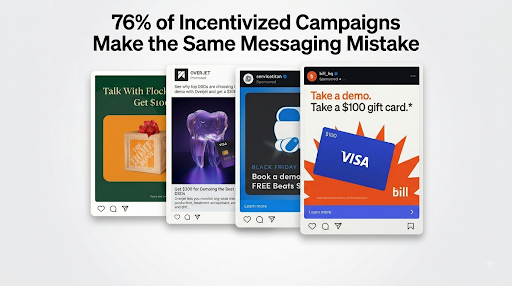
We reviewed 709 incentivized ads with visible body copy. Seventy-six percent follow an identical structure. They open with a product feature, frame the meeting as a demo, and attach the gift card as the closing hook. Only twenty-four percent lead with the value of the meeting itself.
That split isn’t a stylistic preference. It’s the most expensive mistake in the channel, because of what it forces the incentive to do.
Incentives attract. They don’t filter.
When an ad opens with a product feature and calls the meeting a demo, the gift card becomes the only reason a stranger would show up. The incentive ends up doing all the qualifying work on its own.
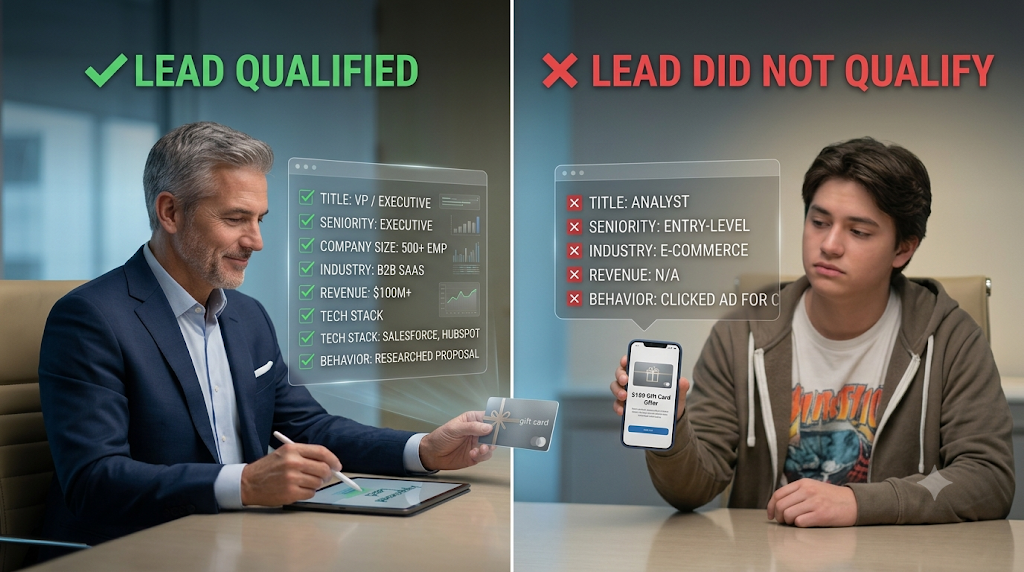
That’s a problem, because incentives are blunt instruments. They attract. They don’t filter. A hundred dollar gift card creates interest indiscriminately, among ideal buyers and among people who collect gift cards as a hobby. When the reward is the entire offer, the campaign optimizes for the wrong thing: maximum attendance, minimum intent.
Make the meeting the offer
The winning twenty-four percent invert the structure. They lead with the value of the meeting itself, not the product.
“Get a custom pipeline analysis of your current demo process” is a fundamentally different offer than “book a demo to see our software.” The first gives a prospect a reason to attend that has nothing to do with whether they end up believing in the product.
They walk away with something either way. The second asks for trust before it has given anything, then sweetens the ask with cash, which is exactly the move that earns this channel its reputation for paying people to show up.
Three rewrites you can steal
The pattern holds across categories. Same product, same incentive, a different offer entirely.
HR software.
Product-led: “See how [Product] automates onboarding. Book a demo, get $100.”
Meeting-centric: “Get a 30 minute teardown of your onboarding workflow, where it leaks time and what best-in-class looks like. $100 for yours.”
Cybersecurity.
Product-led: “Our platform cuts alert noise by 80%. Take a demo, take $150.”
Meeting-centric: “Bring your current alert volume. Leave with a triage benchmark against 200 SOC teams your size. $150 for the half hour.”
Finance software.
Product-led: “Watch [Product] close your books faster. Demo equals a $100 gift card.”
Meeting-centric: “Get a close-process audit. The five bottlenecks we see in month-end, mapped against yours. $100, 30 minutes.”
Notice what changes. The prospect can justify the meeting to themselves, and to their boss, without ever mentioning the gift card. The reward drops into a supporting role. It signals that their time is respected. It stops being the reason to show up.
Why this changes who responds
When a meeting carries its own value, the population that clicks changes with it. Instead of attracting everyone who wants the reward, the campaign attracts people who want the outcome, people who already have the problem the meeting addresses.
That’s a smaller audience, and a far more valuable one. The gift card stops being the pitch and becomes what it should have been from the start: reinforcement.
The opportunity hiding in the stat
Here’s the encouraging read of that seventy-six percent. The bar is low. In most channels, standing out requires outspending or out-creating a genuinely sophisticated field. In this one, getting the offer structure right is enough to land in the top quartile of the entire market. The companies that fix this stand out immediately, in a feed where every competing ad is showing the same gift card and asking for the same demo.
The channel isn’t saturated. The mistake is.
If you want the full messaging analysis, including the survey flow that reinforces meeting value after the click, that’s the kind of architecture we build into every campaign at SweepLift.